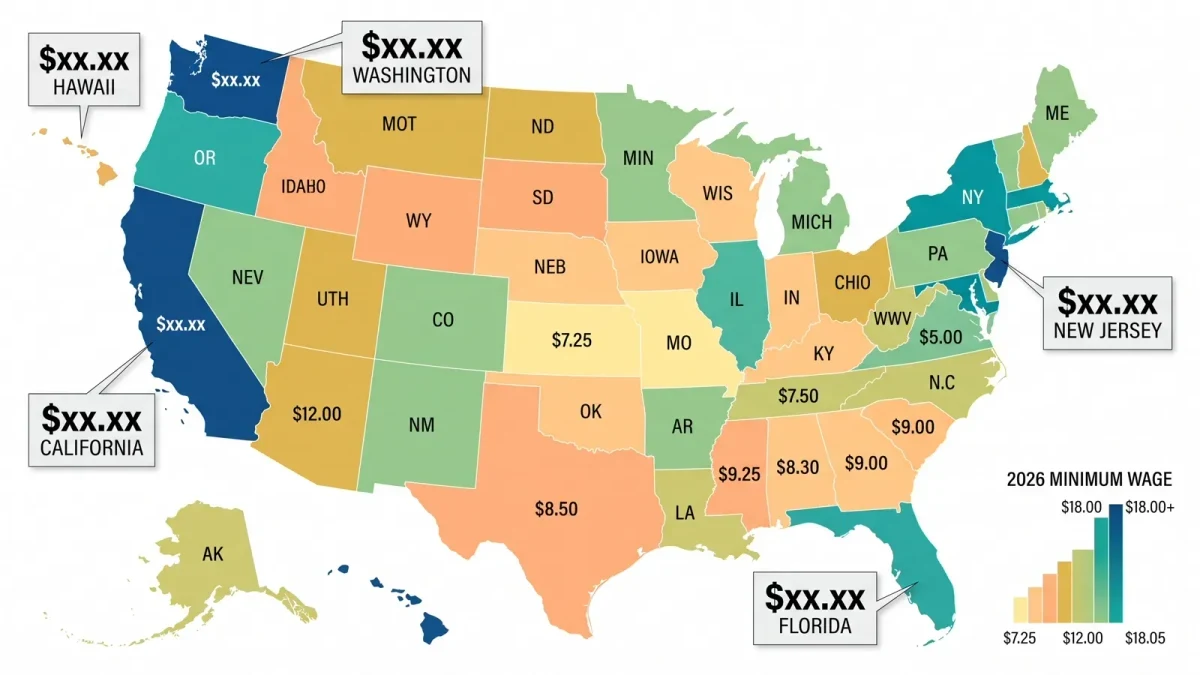
Nearly 20 states and more than 40 cities and counties raised their minimum wages on January 1, 2026, the largest batch of increases since 2023, per the Labor Department's state minimum wage table and the National Conference of State Legislatures. The federal floor remains $7.25 an hour, unchanged since 2009 — the longest stretch without a federal increase since the minimum wage began in 1938.
Which states saw the biggest increases?
Hawaii posted the largest jump, rising $2.00 to $16.00 an hour, with a tipped rate of $14.75, under the schedule the legislature adopted in 2024. California's statewide rate rose to $16.90 for all employers, ending its small-employer tier. Florida reached $15.00, completing the $1-per-year phase-in voters approved in the 2020 Amendment 2 referendum. Michigan's rate rose to $13.73 on its scheduled schedule, though pending litigation over a 2018 ballot measure could push it higher during the year. New Jersey hit $15.92, and Washington state's inflation-indexed rate kept it among the highest statewide floors in the country.
- Hawaii: $16.00, up $2.00 — the largest single increase.
- California: $16.90 for all employers.
- Florida: $15.00, final step of the voter-approved phase-in.
- New Jersey: $15.92; Michigan: $13.73 pending court review.
How do the increases reach workers?
Most of the January 1 moves come from two mechanisms: ballot measures and statutes that set stepped schedules, and state laws that index the rate to inflation annually. Colorado, Arizona, Vermont, Maine, and roughly a dozen others adjusted their rates automatically by their consumer-price formulas. Cities went further: several Bay Area and Seattle-area localities exceeded $17, and New York City's floor stood at $16.50 under the state's wage board system. In states without indexing, the rate stays put until lawmakers act — 20 states, mostly in the South and Plains, either match the federal $7.25 or have no state law at all, per the Labor Department.
What happens next procedurally?
For employers, compliance is a state-by-state question: multi-state businesses recalibrate payroll systems each January, and tipped-credit rules vary sharply between states like Hawaii, which narrows the tip credit, and those that follow the federal $2.13 tipped minimum. In Michigan, a court ruling on the 2018 One Fair Wage ballot initiative could raise the floor further mid-year; the state supreme court has the dispute on its docket. At the federal level, congressional Democrats have reintroduced a $17 floor in each recent session, but no committee vote has been scheduled in the Republican-held Congress.
LMH News publishes information, not employment or business advice. Rates cited reflect the Labor Department's January 2026 state table.