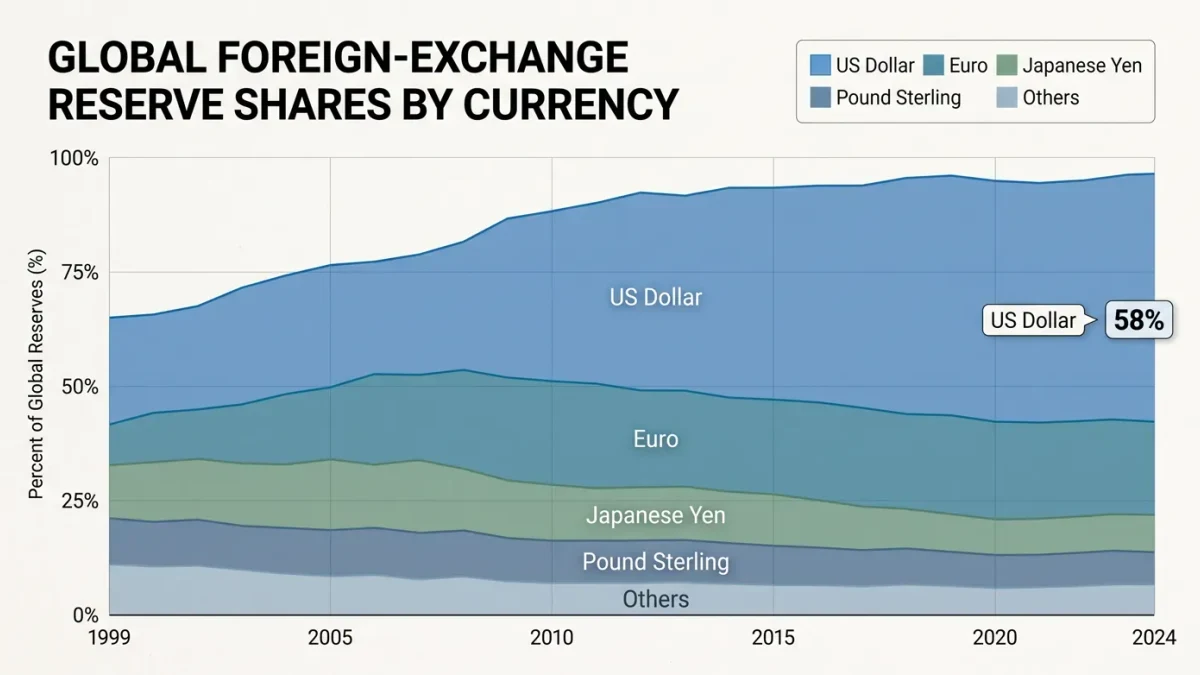
The U.S. dollar is the world's dominant reserve currency: about 58 percent of foreign-exchange reserves held by the world's central banks are dollar-denominated, per the International Monetary Fund's Currency Composition of Official Foreign Exchange Reserves data, and the dollar is involved in nearly 90 percent of global foreign-exchange trading, per the Bank for International Settlements' triennial survey. Reserve status means other countries' governments choose dollars to store value, price trade, and borrow — which gives the United States privileges and vulnerabilities no other country has at the same scale.
How did the dollar get here?
By sequence and stickiness. The pound sterling held the role through the nineteenth century; the dollar displaced it across two world wars, formalized at Bretton Woods in 1944, when 44 nations pegged currencies to the dollar and the dollar to gold. When the U.S. ended gold convertibility in 1971, the system reorganized around fiat money, and the dollar kept the role for reasons that no longer included gold: the sheer depth of U.S. financial markets, the credibility of the Federal Reserve, the rule of law around U.S. contracts, and the fact that everyone else was already using dollars — a network effect. Oil priced in dollars since the 1970s anchored commodity invoicing; dollar-denominated debt across emerging markets anchored borrowing.
What are the privileges of reserve status?
The first is borrowing: foreign governments and investors hold roughly $8 trillion of Treasury securities, per Treasury Department data, keeping demand for U.S. debt high and borrowing costs lower than they would otherwise be. The second is seigniorage and sanctions power — because dollar payments clear through U.S.-correspondent banks, the Treasury can cut countries and actors off from the system, a tool used extensively since 2022 against Russia. The third is the “exorbitant convenience,” as economists have reframed Valéry Giscard d'Estaing's famous phrase: Americans borrow and trade in the currency they print, insulated from the exchange-risk the rest of the world manages.
What are the vulnerabilities?
The mirror of demand is supply: the world's need for dollar reserves requires the United States to run current-account deficits to supply them — the Triffin dilemma, which links reserve status to persistent trade deficits and the manufacturing shifts that follow. Politically, weaponized sanctions have pushed China, Russia, and other states to build alternatives — China's cross-border system, central-bank digital currency pilots, and bilateral local-currency trade deals — though their aggregate scale remains small against dollar networks. And fiscal credibility is the foundation: debt-ceiling brinkmanship in 2011 and 2023 drew explicit warnings from rating agencies, and any scenario in which Treasury securities lost their safe standing would strike at the role's core.
- IMF COFER: ~58 percent of official reserves in dollars; euro ~20, yen and pound single digits.
- BIS survey: dollar on one side of ~88 percent of FX trades.
- Treasury: ~$8 trillion of marketable Treasuries held by foreign holders.
Could the dollar lose the role?
History says yes in principle — sterling did — and no in practice on any near horizon: the euro lacks a unified fiscal backstop, China's capital controls limit the renminbi's usability, and no alternative offers Treasury-market depth. The IMF's reserve shares have drifted down a few points over two decades without a step-change. The realistic risk is not replacement but erosion at the margin: slower reserve accumulation, more bilateral local-currency trade, and a gradually less singular system — a process economists measure in decades, driven less by rivals' appeal than by American policy choices.
Data reflect IMF, BIS, and Treasury publications as of May 2026.