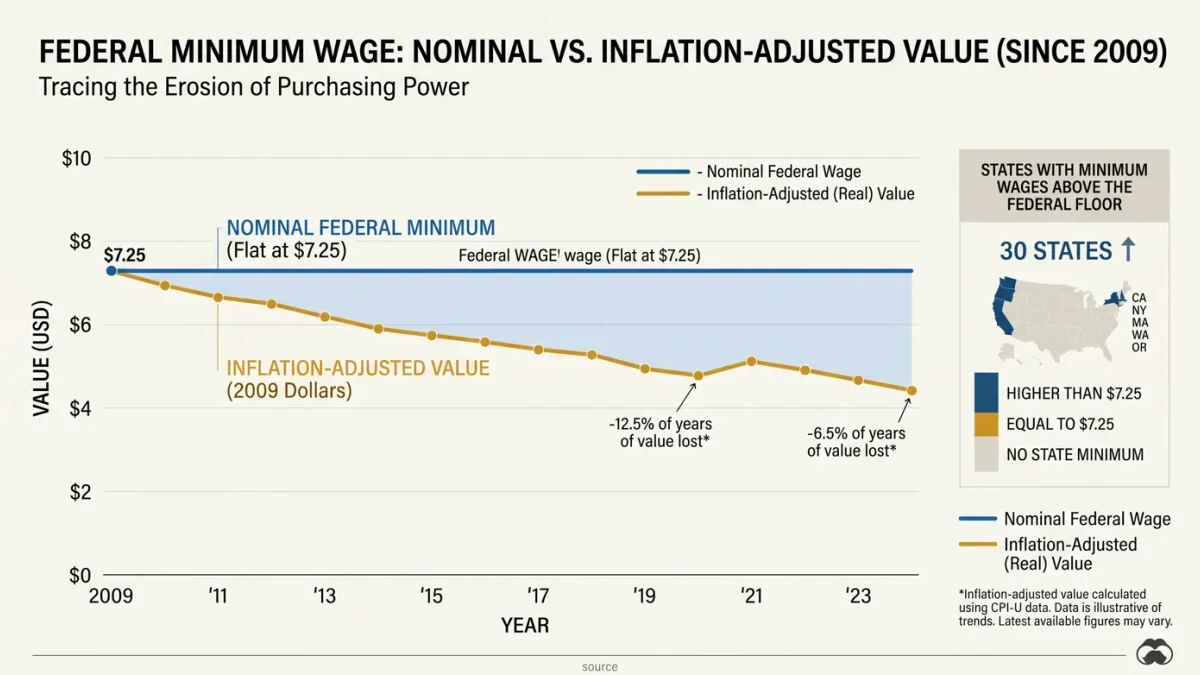
The federal minimum wage has stood at $7.25 an hour since July 2009 — the longest stretch without an increase since the wage began in 1938, and long enough that its real value has fallen by roughly 30 percent to inflation, per Labor Department deflators. Meanwhile the states have moved on: nearly 20 raised their minimums on January 1, 2026, with Hawaii at $16.00, California at $16.90, and Florida completing its climb to $15.00, so the federal floor now binds mainly across the South and Plains. Congressional Democrats have reintroduced a $17 floor in recent sessions; no committee vote has been scheduled.
What is the case for raising it?
Raise advocates — the Raise the Wage Act's sponsors, the Economic Policy Institute, and labor unions including the Service Employees International Union behind the Fight for $15 — make four arguments. Fairness: a full-time worker at $7.25 earns about $15,000 a year, below the poverty line for a family of two; the 1968 minimum's peak real value was above $13 in today's dollars, so current proposals partly restore lost ground. Work incentives: a higher floor makes work pay better than safety-net alternatives, reducing turnover that costs employers too. State evidence: the wave of state increases — 30 states plus D.C. above the federal floor — has been studied extensively, and the pre-2020 consensus research found small employment effects from moderate increases, summarized in the 2019 Congressional Research Service reviews. Power: employers in concentrated local labor markets hold wage-setting power that a floor counters. Their strongest version: the states have run the experiment — more than half the country lives under higher floors, and predicted job losses did not materialize at scale; a federal catch-up indexes the floor to what the labor market already tolerates.
What is the case against?
Opponents — the Employment Policies Institute's economists, the National Federation of Independent Business, and congressional Republicans — argue a single national number is the wrong instrument for a country with a 2-to-1 spread in state median wages. Elasticity: the post-2019 evidence moved — the Seattle and New York studies found employment reductions in low-wage sectors concentrated among less-experienced workers, and the Congressional Budget Office's 2021 analysis of a $15 floor estimated 1.4 million jobs lost on median assumptions against 900,000 lifted from poverty. Pass-through: minimum-wage workers are a minority of those in poverty — many are second earners in non-poor households, and the earned income tax credit and child credit target the poor without a payroll tax on low-skill hiring. Small business: thin-margin employers — restaurants, rural retail — absorb the floor as a cost shock, and tipped-credit elimination raises menu prices and cuts hours, per industry surveys. Their strongest version: the anti-poverty tool that works is the tax code; the minimum wage helps some poor workers while pricing out the least employable — and the honest case for it is redistribution from consumers to workers who keep jobs, not poverty relief.
What does the evidence actually support?
A fair reading of the literature: moderate increases in strong economies show small employment effects; large increases, weak economies, or the teen and restaurant margins show measurable reductions; and both literatures have identification problems honest researchers concede. Policy design mediates — phase-ins, indexing, tipped-credit treatment, and regional tiers change outcomes — and the current American settlement, state floors rising while the federal number stays, is itself the compromise the two camps' strongest versions predict.
LMH News publishes information, not political advice. Positions are attributed to their named advocates; this primer presents each side at comparable length and endorses neither.