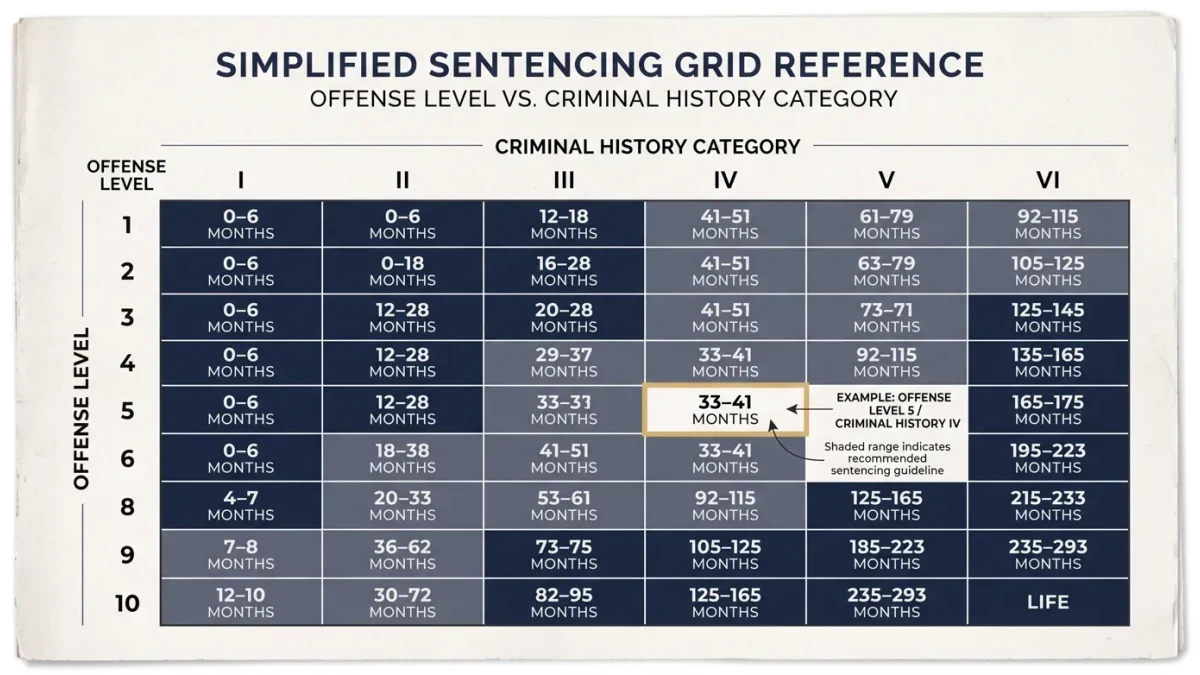
Federal sentencing runs on a grid. The U.S. Sentencing Guidelines, written by the Sentencing Commission under a 1984 statute, assign every federal crime an offense level, add or subtract points for specific conduct, pair the result with the defendant's criminal-history category, and produce a sentencing range in months. From 1987 to 2004 those ranges were mandatory; since the Supreme Court's decision in United States v. Booker (2005) they are advisory — but judges must still calculate them, and sentences inside the guideline range are treated as reasonable on appeal. In fiscal 2024, the most recent full reporting year, more than half of all federal sentences fell within the calculated range, per the Sentencing Commission's statistics.
How is the range computed?
Two axes. The offense level starts with a base level for the crime — fraud starts at 6 or 7 and climbs with the dollar loss table, a drug offense with the drug type and weight — then specific-offense characteristics adjust it: a gun used in connection with another felony adds points, a hate-crime motivator, abduction, or breach of trust adds more. Victim-related adjustments and the defendant's role — minor, minimal, aggravating — move the level up or down, and an acceptance-of-responsibility reduction of up to 3 levels rewards a timely guilty plea. The second axis is criminal history: prior sentences earn points by length and recency, sorted into six categories. Where the row meets the column on the sentencing table is the range: for example, offense level 22 with category I yields 41 to 51 months.
- Base offense level from the guideline for the statute of conviction.
- Specific-offense adjustments and role adjustments.
- Acceptance-of-responsibility reduction, usually −2 to −3.
- Criminal-history points and category.
- Range read from the sentencing table; departure or variance with reasons.
What can move a sentence outside the range?
Two distinct mechanisms. Departures are guideline-sanctioned moves for situations the Commission anticipated: substantial assistance to prosecutors (the common 5K1.1 motion), fast-track programs, or aggravating circumstances nobody modeled. Variances are Booker's legacy: a judge's reasoned departure from the range under the statutory factors in 18 U.S.C. § 3553(a) — the history and characteristics of the defendant, the purposes of sentencing, and consistency with similar cases nationwide. Appellate review exists but defers: a within-range sentence is presumptively reasonable in most circuits, and the judge need only explain a variance adequately enough for appellate review.
Who writes the guidelines, and how do they change?
The Sentencing Commission — seven voting members appointed by the president and confirmed by the Senate, by law including at least three federal judges — meets annually to amend the guidelines, sending each year's amendments to Congress, which has 180 days to disapprove before they take effect. Amendments have tracked policy waves: the 2010 Fair Sentencing Act's crack-powder changes were incorporated retroactively, the 2023 amendments shortened some drug and firearm ranges and were applied to over 10,000 existing sentences, and the Commission's ongoing work addresses acquitted-conduct scoring — a practice a majority of justices questioned in a 2024 concurrence — and fentanyl analog weights. When the commission lacks a quorum, as happened from 2017 to 2022, no amendments pass and the guidelines freeze.
Why do the guidelines still dominate if they are only advisory?
Institutional gravity. Probation officers compute them in every presentence report, prosecutors negotiate charges and pleas with an eye on the math, and appellate doctrine makes within-range sentences the safe harbor. Booker converted the grid from law to anchor — but in a system deciding tens of thousands of sentences a year, the anchor still sets the drift.
LMH News publishes information, not legal advice. Statistics and procedure reflect U.S. Sentencing Commission publications as of April 2026.