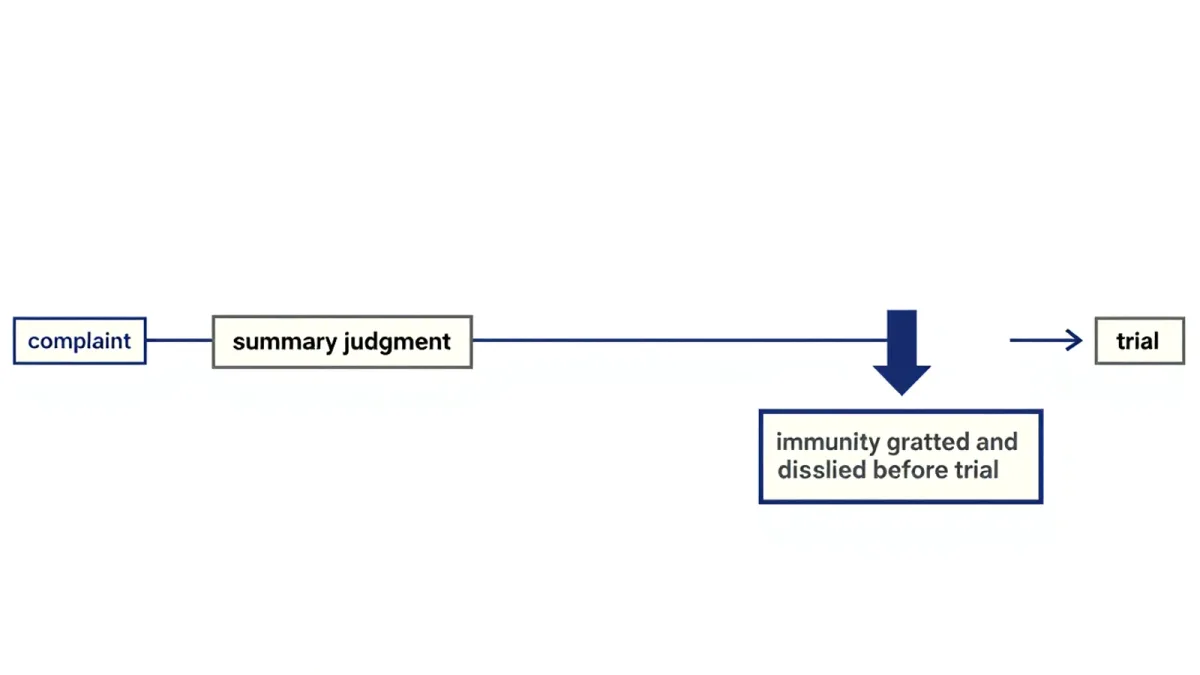
Qualified immunity is a judge-made defense that protects federal, state, and local officials from damages liability in civil rights lawsuits unless they violated a constitutional right that was clearly established at the time. It is not in the statute: Congress's Civil Rights Act of 1871, Section 1983, promised damages for constitutional violations, but the Supreme Court built the doctrine in Pierson v. Ray (1967) and Harlow v. Fitzgerald (1982), the latter holding that officials lose immunity only when their conduct violates “clearly established statutory or constitutional rights of which a reasonable person would have known.” The practical question in most excessive-force cases is therefore not whether the officer's act was unconstitutional, but whether a prior case with closely matching facts put the officer on notice.
How does the clearly-established test work in practice?
Plaintiffs generally need a prior judicial decision — usually from the Supreme Court or their own circuit — finding a violation under facts similar enough to give fair warning. The Supreme Court has said the rule is not a “heavy burden” of identical facts, in cases like Kisela v. Hughes (2018), but its reversals of denial-of-immunity rulings have set a demanding standard: officers in Kisela, White v. Pauly (2017), and Rivas-Villegas v. Cortesluna (2021) received immunity despite concededly tragic outcomes, because no prior case matched closely enough. Critics note the matching requirement can produce a Catch-22 — the first officer to commit a novel violation goes free, and no precedent ever gets established — while defenders answer that general constitutional rules, like the Graham v. Connor (1989) objective-reasonableness standard, do give notice without fact-matching.
What can a plaintiff still get?
Qualified immunity bars personal damages awards, not everything. It does not block declaratory or injunctive relief, does not apply to local governments themselves — municipalities face liability under Monell v. Department of Social Services (1978) for policies or customs causing violations, without an immunity defense — and does not prevent criminal prosecution, which follows an entirely separate track. Officers are also frequently indemnified: studies of large departments, including a 2014 study by UCLA law professor Joanna Schwartz covering dozens of agencies, found governments paid roughly 99 percent of damages in police suits, so immunity doctrine's real effect is on who may be sued and what claims survive to discovery, more than on who ultimately pays.
Where is the doctrine heading?
The Supreme Court has twice declined invitations to reconsider qualified immunity outright — Justice Clarence Thomas and Justice Sonia Sotomayor have each criticized it from opposite directions, Thomas questioning its textual basis, Sotomayor its real-world effects. The action has moved to the states: Colorado ended the defense for state constitutional claims by statute in 2020, New Mexico followed in 2021, and roughly a dozen states have limited or modified it at the state level, per the National Conference of State Legislatures. Congress has debated ending it in federal law repeatedly since 2020, most prominently in the George Floyd Justice in Policing Act, which foundered on exactly this issue.
- Barred by immunity: personal damages against the individual official.
- Not barred: injunctions, municipal Monell liability, criminal prosecution.
- State trend: a dozen-plus states modifying the doctrine for state-law claims.
Why does the debate persist?
Because it is a trade-off between two goods. One side sees a roadblock to accountability for constitutional violations — the Institute for Justice and the Cato Institute's public-interest litigation both document cases dismissed despite acknowledged misconduct. The other side sees insulation necessary for split-second judgment: officials cannot perform discretionary duties if every disputed call risks personal ruin. The Supreme Court's answer has been to leave the doctrine in place while softening edges — ordering district courts to skip the clearly-established question and decide the constitutional one first, in Hope v. Pelzer's progeny and the 2021 Rivas-Villegas line, precisely so precedent accumulates.
LMH News publishes information, not legal advice. Doctrine described follows Supreme Court precedent as of April 2026.