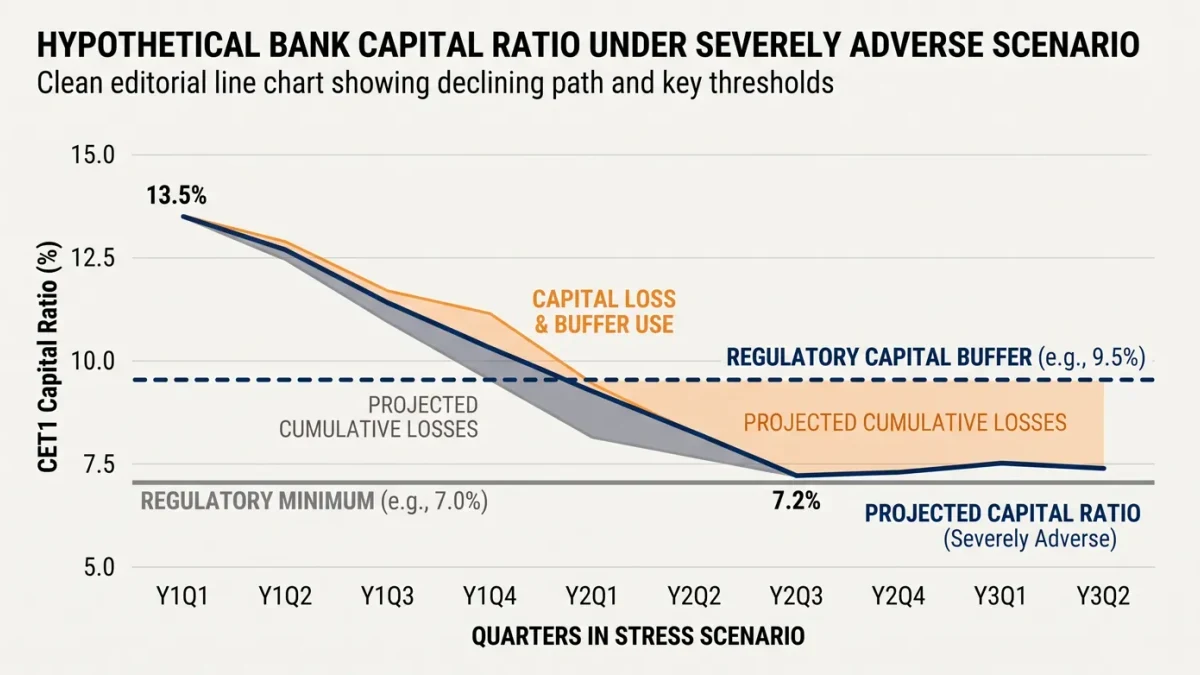
The Federal Reserve's annual stress test is the supervisory exercise at the center of big-bank capital regulation: each year the Fed projects how the largest U.S. banks would fare under a severely adverse economic scenario, and the projected losses set the capital buffer each firm must hold above its minimum requirements. The exercise, mandated by the Dodd-Frank Act after the 2008 crisis, covers every bank holding company with $100 billion or more in assets — roughly 30 firms — with the results published each June alongside each firm's allowed capital distributions, per the Fed's annual methodology and results releases.
How does the test work?
The Fed publishes a scenario in February: a narrative of a hypothetical severe recession — unemployment rising several points, stocks falling by half, real-estate prices collapsing — plus, since 2023, an exploratory module testing additional risks like funding stress. Banks submit detailed data, and the Fed's models project nine quarters of losses, revenues, and capital ratios for each firm under the scenario. A bank's minimum projected capital ratio becomes its stress capital buffer — added to the regulatory minimum to produce its actual requirement, generally between 4.5 percent plus 2.5 to several points more. Firms below the buffer face restrictions on dividends and buybacks, not closure.
What is the test's track record?
Supporters — the Fed itself and post-crisis reform architects like former governor Daniel Tarullo — point to the measured outcome: the largest banks entered the pandemic downturn with roughly twice the common-equity capital ratio they held in 2007, per Federal Reserve Bank data, and passed 2020's additional sensitivity analysis mid-crisis without forced recapitalization. Critics on the left, including the Better Markets advocacy group, argue the scenarios have softened and the buffer framework replaced tougher fixed leverage demands. The industry's critique runs the opposite way: in 2024 and 2025 several major banks sued the Federal Reserve over the test's design, arguing its opacity and year-to-year volatility make capital planning arbitrary — the Fed, in response, proposed averaging two years of results and disclosing more model detail, changes still moving through rulemaking as of 2026.
What are the current policy fights?
Three. Volatility: banks' buffers have swung by large margins year to year on model changes the industry says it cannot predict; the reform proposals would average results and publish more methodology. Tailoring: where the $100 billion threshold sits and how mid-size regional banks are treated remains contested after 2023's failures of Silicon Valley Bank and two others — all three below the largest tier — prompted the 2024–2025 Basel III endgame fight over trading-book capital, which the Fed scaled back under industry pressure. Countercyclicality: the test runs one scenario a year, and critics note buffers rise in good times only slowly and do not fall automatically in bad ones, unlike the Fed's own designs in other countries.
- Coverage: bank holding companies above $100 billion in assets.
- Output: stress capital buffer atop regulatory minimums.
- Consequence: buffer breaches restrict payouts, not licenses.
Why should anyone outside banking care?
Because the test is the standing answer to “could 2008 happen again” — the capital it forces determines how big a shock banks can absorb before taxpayer support enters the conversation, and the June results move bank dividend and buyback decisions, and bank stocks, every year. The test's deeper politics are a decade-long argument about how much equity a bank should be required to hold: every point of capital is a point of equity return the industry gives up, and every point is a shock absorber the rest of the economy gains.
LMH News publishes information, not investment advice. Mechanics follow Federal Reserve publications as of June 2026.