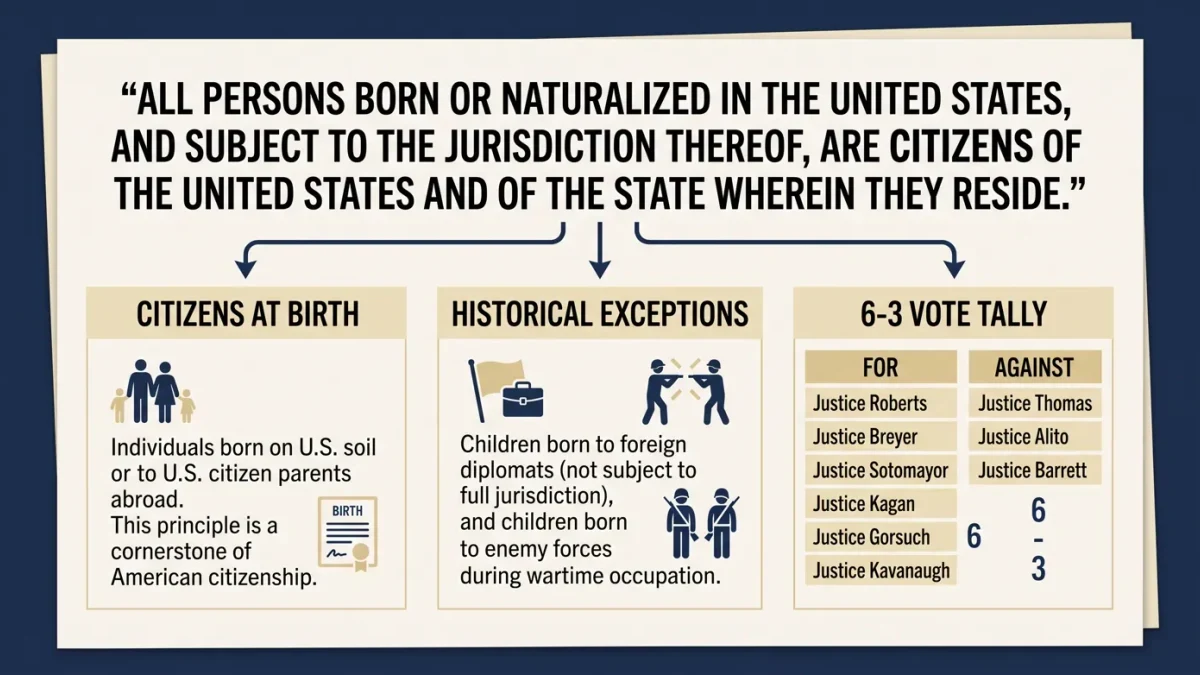
The Supreme Court upheld birthright citizenship on June 30, 2026, holding in Trump v. Barbara that children born in the United States to parents who are unlawfully or temporarily present are “subject to the jurisdiction” of the United States and therefore citizens at birth under the Fourteenth Amendment. The 6–3 ruling, on the term's final decision day, rejected an executive order that had restricted automatic citizenship to children of citizens and lawful permanent residents, per the Court's slip opinion.
What did the ruling decide?
The case consolidated challenges to the executive order signed in January 2025. The majority's opinion traced the Citizenship Clause's text — “All persons born or naturalized in the United States, and subject to the jurisdiction thereof, are citizens” — through Reconstruction history, noting that the 1866 Congress that wrote it, and the 1898 Wong Kim Ark decision, placed the U.S.-born children of noncitizens within the clause, with the historical exceptions limited to children of diplomats and enemy forces, and, later, tribal members under then-governing law. The phrase “subject to the jurisdiction,” the majority held, means subject to U.S. law — which everyone physically present is, absent diplomatic immunity — not subject to a test of permanent allegiance. The dissent argued the clause's original scope excluded children of parents with no lawful permission to remain, reading the jurisdiction phrase as requiring more than legal subjection.
What happens procedurally now?
The order cannot be enforced, and the federal documentation that had been withheld pending litigation — Social Security numbers and passports for affected children — proceeds under ordinary rules. The ruling is final on the constitutional question: reversing it would take a constitutional amendment, since the Court treats its own precedent as the clause's settled interpretation. States had also challenged aspects of the litigation's posture, and the Court's separately issued rulings in the term's injunction cases — including its 2025 CASA decision limiting universal injunctions — shaped how narrowly some remedies were crafted on the way to the merits.
What is the political aftermath?
President Trump said the decision ends the policy route and renewed his call for a constitutional amendment, which needs two-thirds of both chambers and 38 states — thresholds no birthright amendment has approached. Congressional Democrats welcomed the ruling; several Republicans shifted attention to legislation around visa policy and birth tourism, which the ruling leaves to ordinary lawmaking because it addresses children of temporary visitors only as a class already covered. Advocacy organizations on both sides read the decision through the lens of the 2026 midterms, now four months out, with immigration enforcement — the issue that drove the year's two government shutdowns — remaining the cycle's dominant fault line.
LMH News publishes information, not political advice. Facts are drawn from the Court's slip opinion and public statements.