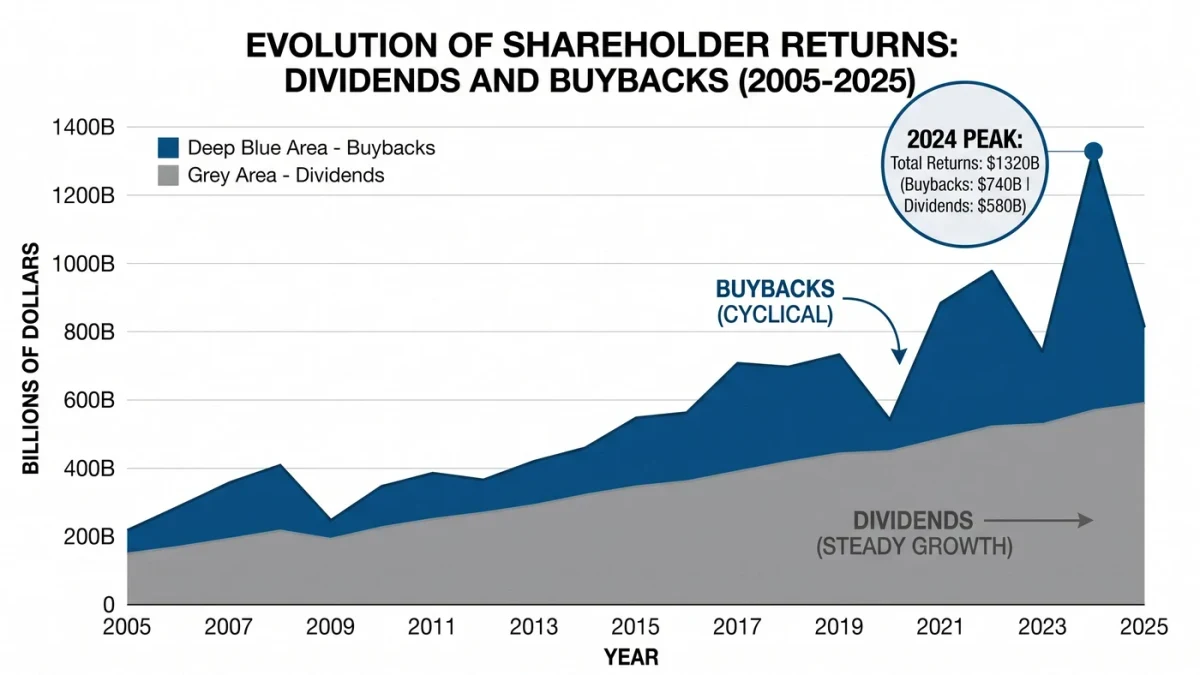
A share buyback is a company using cash to repurchase its own stock from the market, retiring the shares or holding them as treasury stock. The effect is arithmetic: fewer shares outstanding means each remaining share claims a larger slice of future earnings, which is why buybacks lift earnings per share without any change in the business. S&P 500 companies repurchased roughly $800 billion to $940 billion of their own stock annually in recent years, per S&P Dow Jones Indices' buyback dictionaries, with quarterly totals among the most-watched measures of corporate cash deployment — alongside dividends and capital expenditure.
How does a company actually execute one?
Almost always through open-market purchases under a board-authorized program: the board approves a ceiling — say, $10 billion over two years — and the company buys at management's discretion, disclosing totals quarterly. The mechanics run under Securities and Exchange Commission Rule 10b-18, which provides a safe harbor from manipulation liability if the company sticks to volume, price, and timing limits — no more than 25 percent of average daily trading volume, single broker, end-of-day pricing. Companies also use accelerated share repurchases, paying a bank upfront for a block, and occasional tender offers. Since 2023, the Inflation Reduction Act's 1 percent excise tax applies to net repurchases, and the SEC's amended Rule 10b5-1 requires next-business-day disclosure of buyback transactions in quarterly filings.
Why do companies do it?
Management's stated logic is capital return with flexibility: unlike dividends, buybacks carry no expectation of permanence and can be throttled in bad years without the market punishment a dividend cut invites. The economic logic is signaling and arbitrage — a buyback tells the market management believes the stock is undervalued, and retiring shares concentrates ownership among remaining holders. Critics, including Senator Elizabeth Warren and economist William Lazonick in his much-cited Harvard Business Review analysis, argue buybacks have become a default use of cash that starves investment: over the 2010s, several large tech and pharma firms spent more on repurchases than on research and capital projects combined, per their own 10-K disclosures.
Who actually benefits?
Shareholders who keep their shares — including, at market-wide scale, index-fund savers — gain pro-rata from the reduced share count. Executives whose compensation is tied to per-share metrics gain mechanically, a conflict critics highlight. Employees benefit only indirectly if the alternative uses — capex, wages, hiring — were worse investments, which is precisely the empirical dispute. Sellers of the shares receive cash at market price, neither better nor worse off than any sale. The aggregate effect on the stock market is contested: buybacks add a persistent net buyer of equities, but they are funded from corporate cash that would otherwise sit in financial assets, so the net-wealth effect is smaller than headline totals suggest.
- Mechanism: fewer shares, higher earnings per share.
- Rules: SEC Rule 10b-18 safe harbor; 1 percent excise tax since 2023.
- Alternatives: dividends, capital expenditure, M&A, debt paydown, wage investment.
What is the policy debate?
Proposals in Congress have ranged from banning buybacks by companies receiving federal subsidies and government contracts to raising the excise tax to 4 percent — bills reintroduced in recent sessions without committee action. The counterargument, from corporate finance economists, is that restricting buybacks does not force investment; it traps cash, and firms without good projects should return money to shareholders who can redeploy it. The live empirical question — whether buyback-heavy firms underinvest — has produced mixed results, with studies splitting on whether repurchases precede weaker innovation or simply follow cash-rich maturity.
LMH News publishes information, not investment advice. Figures reflect index-provider and SEC data as of April 2026.