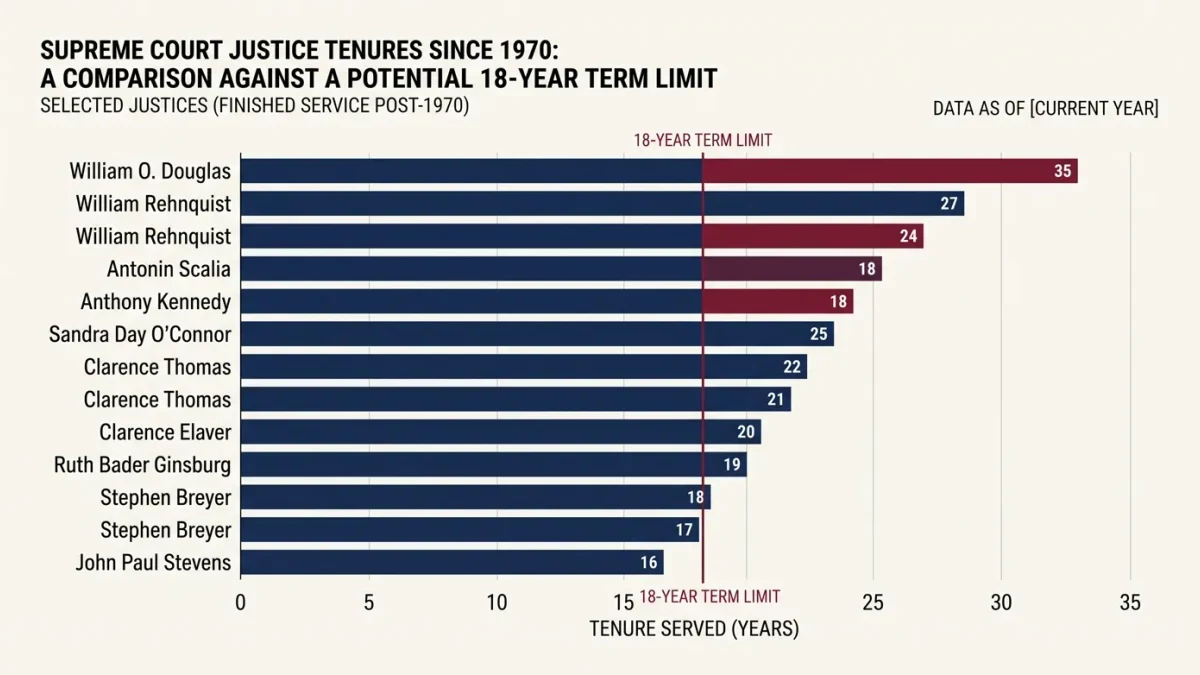
Supreme Court justices serve during good behavior — life tenure, under Article III — and the average tenure of departing justices has grown from about 15 years at the founding era to roughly 26 years since 1970, per research compiled by the Pew Research Center. Because vacancies are unpredictable and confirmations are now bare-majority partisan fights, each seat's timing can shape constitutional law for a generation. Proposals for 18-year staggered terms have drawn support from across the political spectrum; opponents argue the cure is worse than the disease.
What is the case for term limits?
Term-limit advocates — a list that has included legal scholars across party lines, former Attorney General Eric Holder's National Democratic Redistricting Committee, and Republicans like Senator Marco Rubio in earlier Congresses, along with a 2024 report by the bipartisan Presidential Commission on the Supreme Court of the United States that treated term limits as the most viable reform — argue that staggered 18-year terms would regularize vacancies: one seat every two years, each presidential term yielding two appointments. Their claims: life tenure plus strategic retirement lets justices time departures for friendly presidents, as Justice Stephen Breyer's 2022 retirement for a same-party successor illustrated; vacancies have become lottery events — Antonin Scalia's death in 2016 froze the Court's direction for a year of constitutional confrontation; and life expectancy has transformed the Founders' assumption, producing 30-plus-year tenures no eighteenth-century framer anticipated. The strongest version: staggered terms would lower the stakes of each confirmation, drain the apocalyptic politics from vacancy battles, and keep the Court closer to the electoral timeline without subjecting justices to reelection.
What is the case against term limits?
Opponents — Justice Elena Kagan has publicly noted the framers designed life tenure to protect judicial independence, and Senate Republicans including the judiciary committee's leadership have rejected term-limit bills as unconstitutional restructuring — make three arguments. Constitutional text: Article III's good-behavior clause means only amendment, or a constitutionally dubious statute structuring the Court around senior-status rotations, can impose terms; an 18-year plan requiring outgoing justices to take senior status and sit on lower courts, they argue, is a life-tenure evasion that will be litigated the first time a rotated justice's vote matters. Independence: the whole design insulates judges from political calendars; a justice counting down to a fixed exit date, or hoping for a post-Court career, has a new set of incentives. Institutional stability: the current Court's long tenures give constitutional law continuity, and term limits would let a two-term president appoint a majority — five of nine — which no single electoral outcome has done since the current appointment regime's confirmation rules changed in 2017. Their strongest version: the frustration driving term limits is about particular rulings, not tenure structure, and restructuring the third branch to change outcomes is exactly the court-packing impulse the Constitution guards against.
How would each proposal actually work?
The leading bills — introduced in several recent Congresses with bipartisan sponsors — set 18-year terms, staggered so a vacancy opens every two years, with former justices sitting by designation on the appeals circuits. That structure tries to dodge Article III: justice is not removed, merely moved. Whether it survives a constitutional challenge is untested. A constitutional amendment setting terms — the route term-limit advocates concede is cleanest — has never approached the two-thirds congressional threshold, and polls show majority public support for term limits without translating into amendment momentum.
LMH News publishes information, not political advice. Positions are attributed to their named advocates; this primer presents each side at comparable length and endorses neither.