When the federal government gets close to its borrowing limit, the news fills with talk of deadlines and default. The standoff feels new every time. It is not. Congress has set a limit on federal debt for more than a century, and fights over raising it have ended the same few ways.
Looking at how past standoffs ended gives a calmer picture than the daily headlines do. Most ended in a plain vote to raise the limit. Some ended in a temporary suspension of the limit. A few ended with a rule change that removed the vote entirely. Each path has a track record.
Why a Ceiling Exists at All
Under Article I, Section 8 of the Constitution, only Congress can authorize borrowing on the credit of the United States. Until 1917, Congress approved each debt issue on its own terms. The debt ceiling dates to the Second Liberty Bond Act of 1917, which set an overall cap on new bonds so the Treasury had more room to finance the war. The Public Debt Acts of 1939 and 1941 then shaped the modern form: one limit covering nearly all federal debt.
The Buffer Called Extraordinary Measures
When the Treasury nears the limit, payments do not stop the next day. The department can declare a debt issuance suspension period and take what officials call extraordinary measures. These steps include suspending new investments in federal retirement funds, such as the G Fund of the Thrift Savings Plan. Similar steps were taken in 2011 with the Civil Service Retirement and Disability Fund and the Postal Service Retiree Health Benefits Fund. Treasury officials have been clear that these moves buy weeks, not months. The cash runs out if the limit stays in place. Readers following this should also see Should the Federal Minimum Wage Rise? Both Sides' Best Case.
The 1953 Standoff: An Early Preview
An early test came in 1953. President Eisenhower asked Congress on July 30, 1953 to raise the ceiling of $275 billion, and the Senate refused to act. The president told federal agencies to reduce what they spent. The Treasury leaned on its cash balances at banks. Starting in November 1953, it monetized close to $1 billion of gold left in its vaults to stay under the limit. Talks followed, and a $6 billion increase passed on August 28, 1954. The pattern still holds. Standoffs tend to end with a negotiated raise once delay starts to hurt both sides. We covered a connected angle in Should the Social Security Retirement Age Rise? Both Sides' Best Case.
When a Rule Replaced the Vote
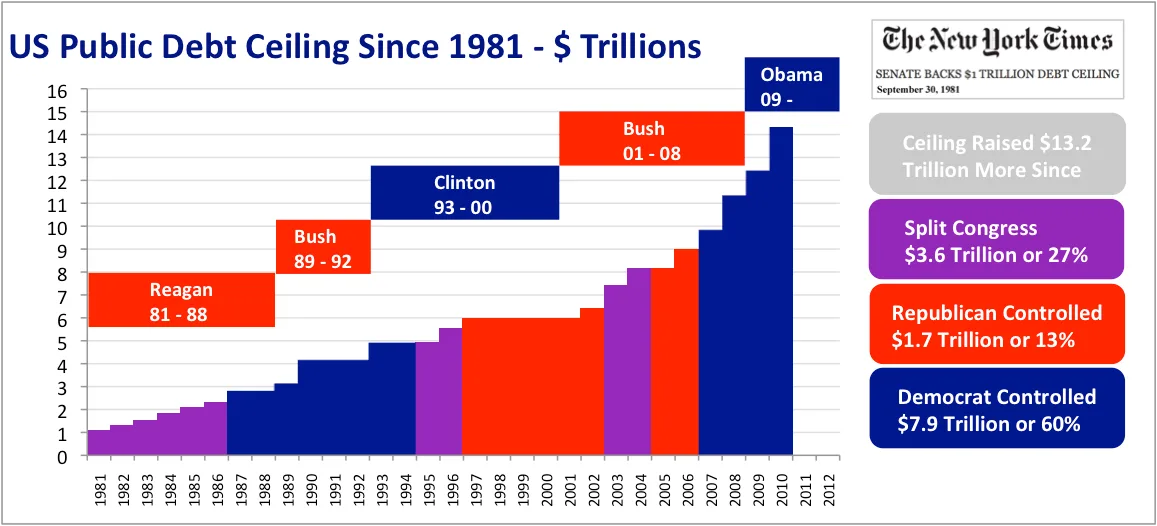
There is also a structural path: remove the recurring vote. In 1979, Dick Gephardt put in place a parliamentary rule that deemed the ceiling raised whenever a budget passed. The rule stood until 1995. Under it, Congress raised the limit many times without a separate vote, including eighteen increases during the Reagan years and nine under President George H.W. Bush. Raising the limit was, for decades, a routine formality between the White House and Congress rather than a hostage to other fights.
The 2011 Crisis and Its Price Tag
The modern standoff arrived in 2011. The delay in raising the limit led to the first downgrade of the United States credit rating on August 5, 2011, and the Dow fell hard in late July and August of that year. The Government Accountability Office estimated that the delay raised federal borrowing costs by $1.3 billion in fiscal 2011 alone. The Bipartisan Policy Center extended that estimate and put the ten-year cost at $18.9 billion. The standoff ended with the Budget Control Act of 2011, passed as the deadline arrived.
The Modern Exit: Suspension
Recent standoffs have often ended with a newer tool. Instead of raising the limit to a fixed number, Congress suspends it for a set period and lets borrowing rise as needed. The No Budget, No Pay Act of 2013 suspended the ceiling until May 19, 2013. An October 2015 law suspended it to March 2017. A 2019 deal suspended it for two years. The Fiscal Responsibility Act of 2023 suspended it through the end of 2024.
Conclusion: Three Doors Out of a Standoff
History shows that a standoff ends in one of three ways. Congress raises the limit, as it did after 1953. It suspends the limit for a time, the usual path since 2013. Or it changes the rules so the vote disappears, as under the Gephardt Rule. Every past deadline has passed without a true default on the debt. The exits are well worn, even when the walk to them is slow.