The United States courts of appeals — the 11 numbered regional circuits, the D.C. Circuit, and the Federal Circuit — decide roughly 45,000 appeals each year, per the Administrative Office of the U.S. Courts' statistics. They are the courts of last resort for the overwhelming majority of federal cases: fewer than one percent of their decisions are reviewed by the Supreme Court. When a circuit rules, its interpretation of federal law binds every district court within its borders, which is why where a case is filed often matters as much as what it argues.
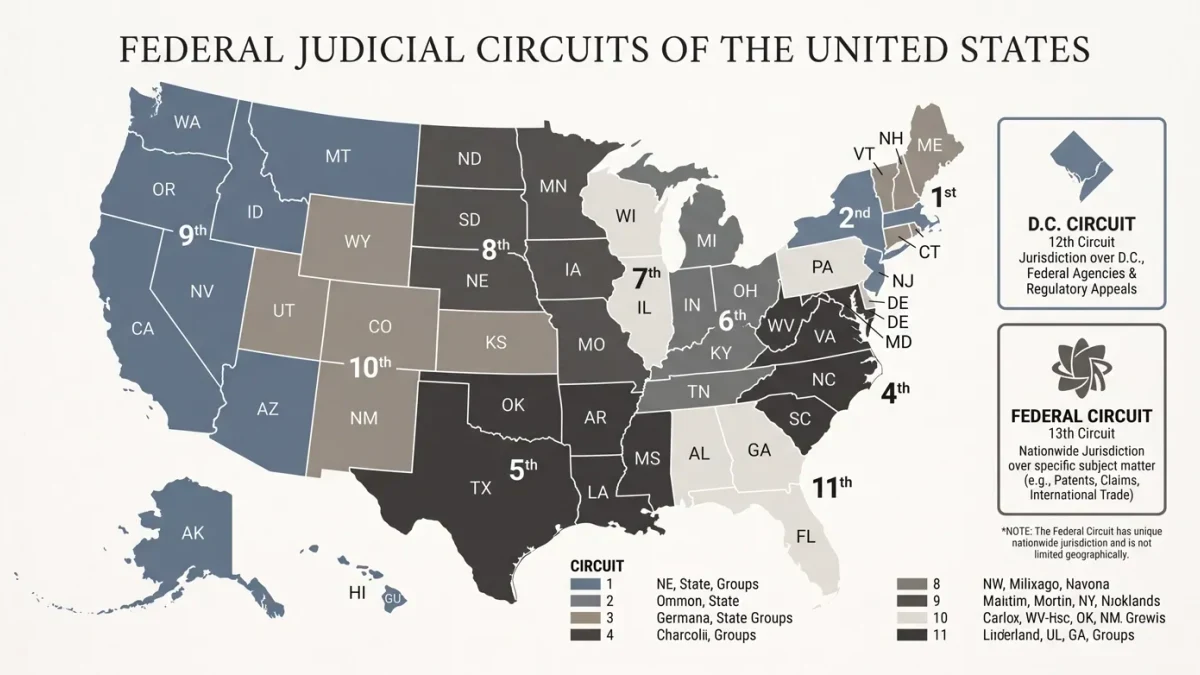
How is the circuit map organized?
Each numbered circuit covers several states: the Ninth Circuit spans nine western states plus Guam and the Northern Mariana Islands; the Fifth Circuit covers Texas, Louisiana, and Mississippi; the First, the six New England states. Each state contains one or more federal district courts — 94 nationwide — where trials happen. Appeals go to the circuit whose territory includes the district court. Three judges, drawn by random assignment from the circuit's bench, hear each appeal; en banc rehearings before the full circuit are rare. The D.C. Circuit hears agency challenges and federal-government disputes whatever their geography, which is why so many regulatory fights land there, and the Federal Circuit has nationwide jurisdiction over patents, trademarks, and certain claims against the United States.
What can a circuit court do with a case?
Appeals are about legal error, not re-running trials. The panel reads the record, hears argument from both sides — typically 15 to 30 minutes per case — and decides whether the district judge applied the law correctly, applied the right legal standard to facts found at trial, or abused discretion in rulings like evidence or sentencing. A panel can affirm, reverse, remand for further proceedings, or some mix. It does not hear witnesses or take new evidence. Written opinions cite circuit precedent, called circuit law: absent an intervening Supreme Court decision or an en banc reversal, a three-judge panel cannot overrule a prior panel of the same circuit.
Why do circuit splits matter?
Because federal law then means different things in different parts of the country. If the Ninth Circuit reads a statute to allow a claim and the Fifth Circuit reads it not to, identical cases get opposite outcomes based on the courthouse door. A published circuit split is the single strongest predictor that the Supreme Court will grant review, since uniform federal law is the reason the Court exists in the constitutional design. Recent terms have featured splits resolved on everything from the definition of an automatic telephone dialing system to the validity of nationwide injunctions — the latter settled by the Court's June 2025 ruling in CASA v. Department of Education limiting universal injunctions.
How are circuit judges chosen?
Like all Article III judges, circuit judges are nominated by the president and confirmed by majority Senate vote, serving during good behavior — effectively for life. Since November 2013, filibusters do not apply to judicial nominations below the Supreme Court, and since April 2017 not to the Supreme Court either, so confirmation needs a simple majority. Circuit judgeships have become presidential priorities precisely because circuits shape policy between Supreme Court rulings: a judge's senior status creates a vacancy, and the pace of confirmations depends on Senate control, which changes with each election.
LMH News publishes information, not legal advice. Court statistics reflect the Administrative Office of the U.S. Courts as of its 2025 reports.