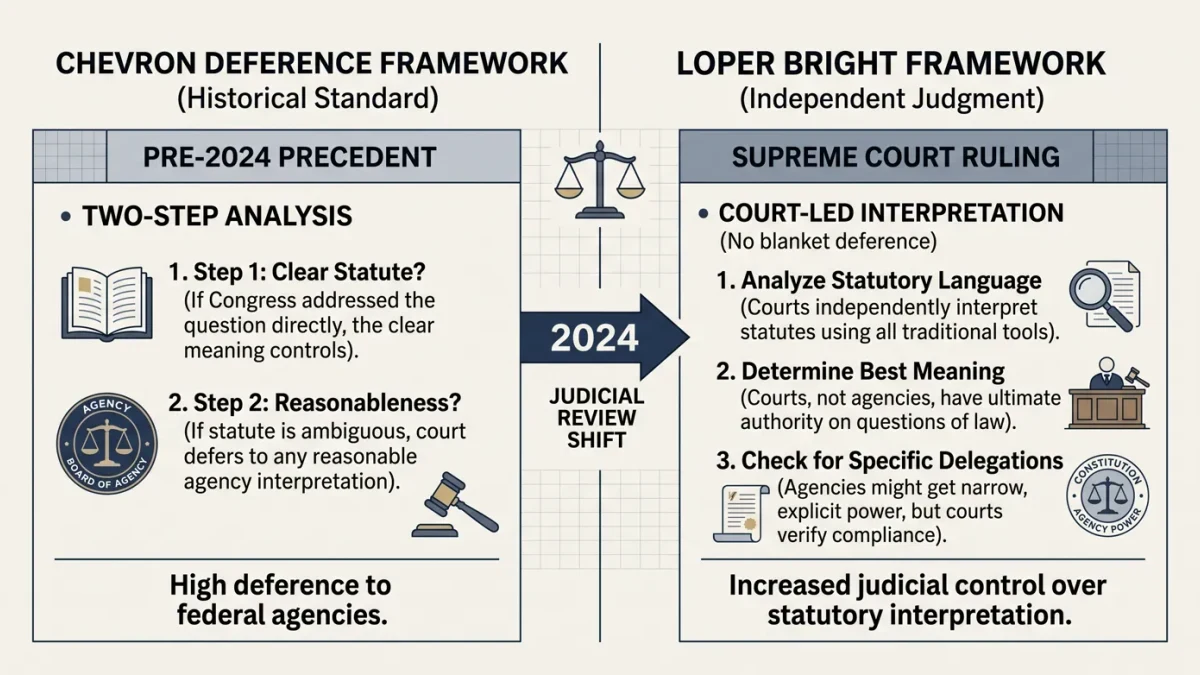
When the Supreme Court decided Loper Bright Enterprises v. Raimondo on June 28, 2024, it overruled Chevron U.S.A. v. NRDC, the 1984 precedent under which courts deferred to agencies' reasonable readings of ambiguous statutes. The question now settled: courts exercise independent judgment on what federal laws mean. The question still being litigated: how much that changes in practice. Two years of decisions suggest the answer is — less than defenders of Chevron feared in some areas, more in others, and still forming.
What did Chevron actually do?
Under Chevron, a court confronting an ambiguous statute asked whether the agency's reading was reasonable, and if so deferred to it. Because agencies are staffed experts and politically accountable through the president, the doctrine made agencies the effective arbiters of statutory meaning in their domains — everything from the EPA's reading of “waters of the United States” to the FCC's net-neutrality authority. Critics across the ideological spectrum — the late Justice Antonin Scalia soured on it, and progressive scholars disliked it when agencies deregulated — argued it let Congress delegate too much and courts abdicate.
What does Loper Bright require instead?
Courts must now decide statutory meaning themselves, using the traditional tools — text, structure, history, purpose — while remaining free to weigh the agency's interpretation as one persuasive input, in what the Court called a respectful consideration under the Administrative Procedure Act's arbitrary-and-capricious review. Crucially, Loper Bright preserved all prior holdings that relied on Chevron deference — only future interpretations are open — and it did not touch the major-questions doctrine from West Virginia v. EPA, which had already narrowed agencies' room in big-ticket cases.
What has actually changed in the courts?
The early pattern, per case-tracking analyses by administrative-law scholars and practice trackers through 2026: challenges to agency interpretations succeed more often, particularly in district courts reviewing new rules, where judges no longer search for a permissible construction to affirm. A second effect is doctrinal migration: arguments that used to be fought over Chevron reasonableness now arrive as statutory-text disputes — plain-meaning battles over words like “chemical” and “emit” — and as major-questions challenges, which grew as the fallback anti-agency tool. A third is forum concentration: with deference gone, the choice of circuit matters more, and consolidated challenges to national rules cluster in a predictable set of venues. What has not happened: a collapse of the administrative state — agencies still win when statutory text genuinely supports them, and Congress, prodded by the new regime, has shown some renewed appetite for statutory clarity in major authorizations.
- Then: agency reading reasonable → court defers.
- Now: court decides meaning; agency view weighs as persuasion.
- Preserved: pre-2024 Chevron-based holdings stand.
What should regulated parties and citizens expect?
Longer rulemaking preambles, as agencies tie rules tightly to text; more litigation at the interpretation stage rather than the arbitrariness stage; and a premium on who appoints the judges, since interpretive power is now judicial power. For advocates of the change, that is the point — elected Congress writes law, life-tenured judges say what it means, and accountable agencies execute it. For critics, it trades the accountability of presidential administration for the preferences of individual district judges. Both descriptions are accurate; which one you prefer is the two-year-old question Loper Bright reopened.
LMH News publishes information, not legal advice. Analysis follows the Loper Bright opinion and post-2024 litigation as of July 2026.