Every significant federal regulation — clean-air standards, overtime thresholds, food-safety rules — is produced through the notice-and-comment process set by the Administrative Procedure Act of 1946. The statute requires an agency to publish a proposed rule, take public comments for a set period, consider them, and publish a final rule with reasons, all in the Federal Register. Federal agencies issued roughly 3,000 to 4,000 final rules annually in recent years, of which a few dozen each year are the major, economically significant rules that shape national policy, per the Office of the Federal Register's yearly counts.
What are the steps from idea to binding rule?
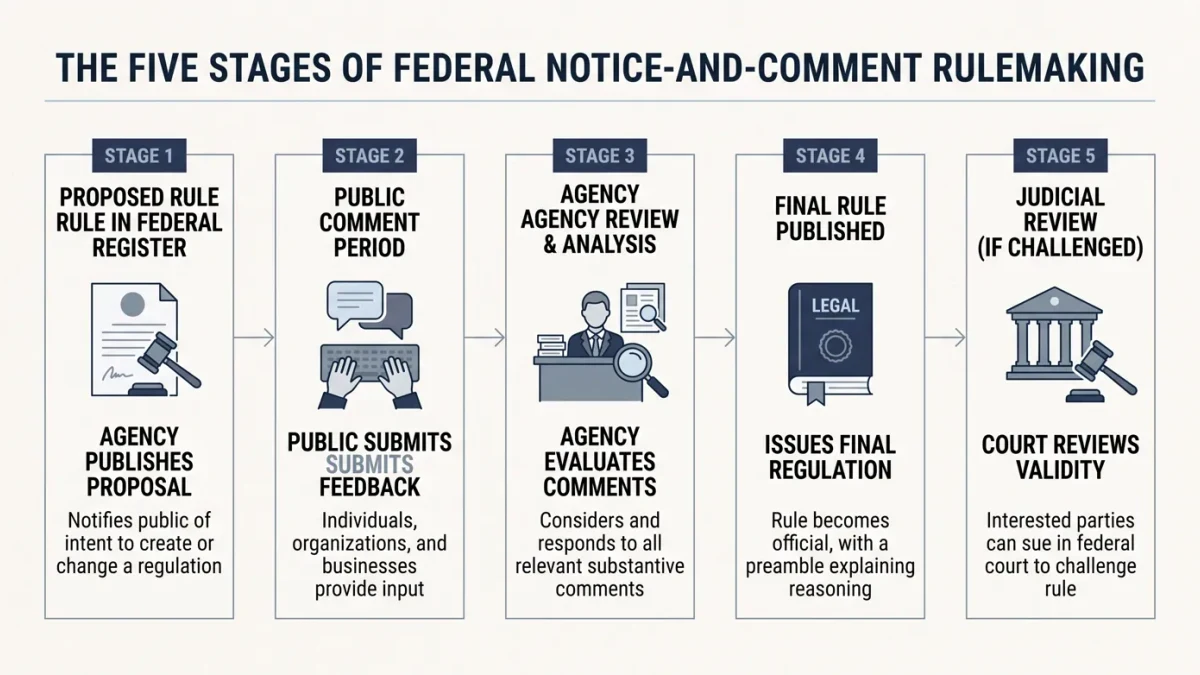
The process begins well before the public sees anything. Most significant rules start on the unified agenda, the twice-yearly list of regulations agencies plan to consider. A draft proposed rule must clear interagency review by the Office of Information and Regulatory Affairs — within the Office of Management and Budget — which analyzes costs and benefits under Executive Order 12866, in force since 1993. Then the sequence runs:
- Publication of the proposed rule in the Federal Register, opening a comment window — usually 30 to 60 days.
- Public comment: any person, company, or group may submit data and arguments; agencies may hold hearings.
- Review and response: the agency must consider significant comments and address them in the final rule's preamble.
- Publication of the final rule, typically with an effective date at least 30 days later.
- Judicial review: parties harmed by the rule may challenge it in federal appeals court.
What limits an agency's power to write rules?
Three constraints bind. First, statutory authority: an agency may regulate only within the power Congress granted, and under the Supreme Court's 2022 decision in West Virginia v. EPA, major questions — rules of vast economic or political significance — need clear congressional authorization. Second, the APA's prohibition on arbitrary and capricious action: the agency must examine the relevant data and articulate a satisfactory explanation, including responding to contrary evidence in the record. Third, procedural completeness: skipping notice and comment, or deciding the outcome before comments arrive, voids the rule — courts scrapped rules in the 2010s where excerpts were copy-pasted from industry submissions without independent analysis.
What happened to Chevron deference?
Until 2024, courts deferred to an agency's reasonable reading of an ambiguous statute under Chevron U.S.A. v. NRDC, the 1984 precedent. In Loper Bright Enterprises v. Raimondo, decided June 28, 2024, the Supreme Court overruled Chevron and held that courts must exercise independent judgment on statutory meaning, while still weighing agency expertise under the APA's silence on ambiguity. The practical effect for rulemaking: agencies now write longer preambles tying rules tightly to statutory text, and challengers frame more cases as pure questions of law that courts decide without deference.
How can Congress or the president undo a rule?
A final rule can be withdrawn through the same process — a new proposed rule explaining the change. Congress can disapprove a major rule within 60 session days under the Congressional Review Act, by joint resolution not subject to Senate filibuster; it has been used over 20 times, most aggressively at the start of 2017 and 2025 when new majorities erased the prior administration's late rules. And an incoming president can order agencies to freeze pending rules — the standard day-one regulatory memo — though rules already in effect require fresh rulemaking to reverse.
LMH News publishes information, not legal advice. Process described follows the APA, executive orders, and Federal Register practice as of January 2026.