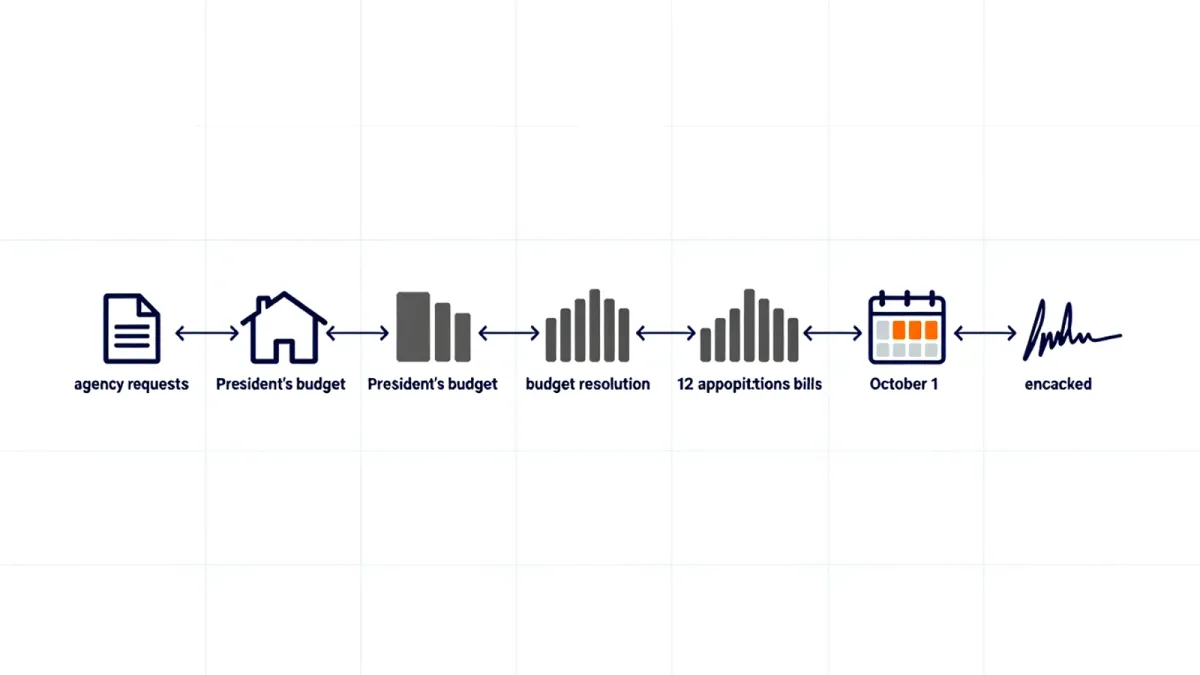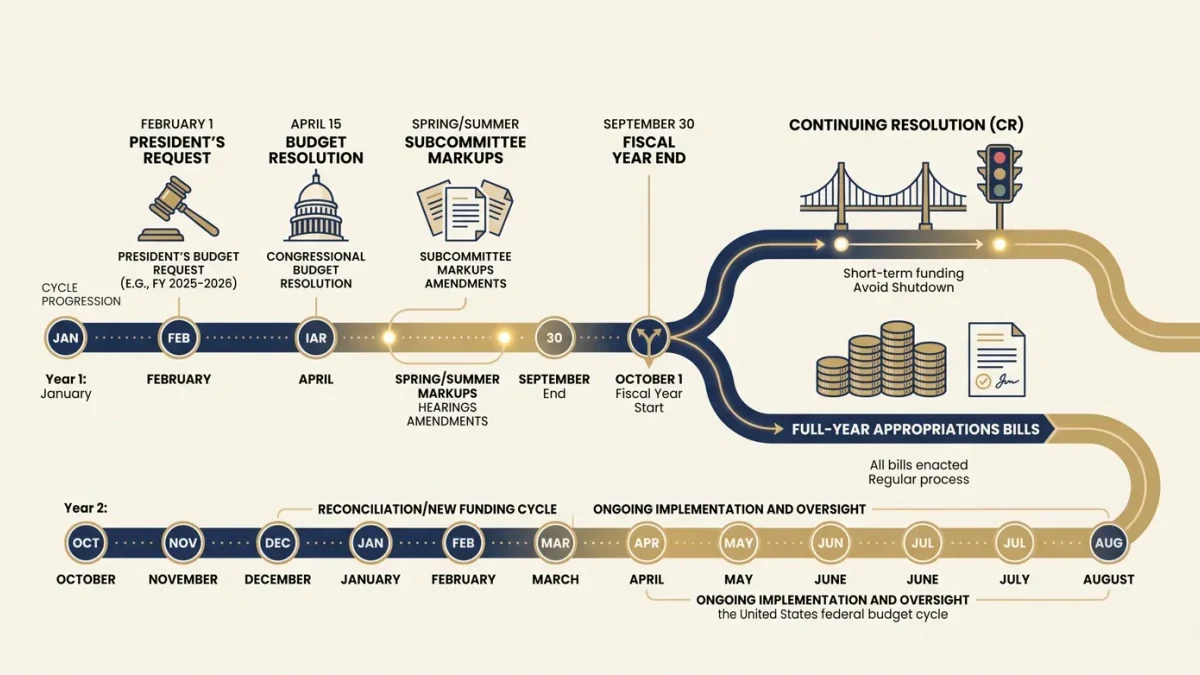
The federal fiscal year runs October 1 through September 30, and the process that funds it starts more than a year earlier. By statute — the Congressional Budget Act of 1974 — the president's budget request is due the first Monday of February, Congress adopts a budget resolution by April 15, the House should pass all 12 appropriations bills by June 30, and everything is supposed to be signed before October 1. On time completion has happened rarely: for decades the standard outcome has been a continuing resolution at the deadline, omnibus packages later, and — as January and February–April 2026 demonstrated — shutdowns when even the stopgap fails.
What are the stages?
The president's request sets a topline: agency-by-agency spending, revenue assumptions, and policy priorities, assembled by the Office of Management and Budget through the fall's passback process, where OMB returns agencies' draft budgets with edits. Congress then writes its own math: the Congressional Budget Office re-estimates the request on neutral assumptions, and the budget committees report a budget resolution — a concurrent resolution, not signed by the president, setting 302(a) totals that cap the appropriations committees, which subdivide them into 302(b) allocations for each of the 12 subcommittees: defense, labor-health-education, transportation-housing, and the rest. The appropriations subcommittees mark up their bills — program-level spending, amendments, reports — and floor action follows, in theory one bill at a time, in practice in bundles.
- February: president's budget request.
- Spring: CBO re-estimate; budget resolution adopted (theoretical deadline April 15).
- Summer: 12 subcommittee markups and floor votes.
- October 1: fiscal year begins — full-year bills, a continuing resolution, or a lapse.
Why is it always late?
Because the incentives reward delay. The budget resolution needs majorities in both chambers, which in narrow-margin Congresses means internal factional deals that take months or never complete — Congress has frequently skipped the resolution entirely and governed by deeming resolutions. The appropriations bills carry the year's policy fights — abortion riders, immigration enforcement, agency budgets — so a single bill can stall on one provision, and the calendar compresses: when August recess ends with three bills done, the remaining nine meet one deadline. The backstop, the continuing resolution, holds last year's spending flat for weeks or months — the 2026 fiscal year began under exactly that structure, with full-year packages following in February and the Homeland Security bill collapsing into a 76-day lapse. And when the debt limit — a separate ceiling on borrowing for spending already enacted — intersects the funding deadlines, the stakes compound to default risk.
What are omnibus and minibus packages?
When the deadline arrives with bills unfinished, leaders bundle them: a minibus combines several bills; an omnibus wraps all or most of the year's spending, often thousands of pages, into one must-pass vehicle with the CR's expiry as the enforcement mechanism. The format trades transparency for closure — member and committee priorities ride along, and the alternative is a shutdown nobody wants to own. Between 2011 and 2021 the Budget Control Act's caps also triggered sequestration threats that forced the deals; since the caps expired, the toplines are negotiated leader-to-leader each cycle.
What should you watch, and when?
The February request for priorities; spring for whether a budget resolution appears; June 30 as the nominal House target; and late September for the CR-or-shutdown decision. The 2027 cycle is already in motion: the president's request went up in February 2026, and the appropriations markups of the coming autumn will carry the year's enforcement-politics fight into the midterm election.
LMH News publishes information, not political advice. The timeline follows the Congressional Budget Act and recent practice as of August 2026.