The Electoral College assigns each state presidential electors equal to its congressional delegation — 538 in total, a majority of 270 to win — and five times in American history, most recently in 2000 and 2016, it has elected a president who lost the national popular vote. Proposals to replace it with a national popular vote range from a constitutional amendment to an interstate compact already joined by 17 states and the District of Columbia. The debate divides along a clear line: whether the presidency should express one national majority or a federal composite of state majorities.
What is the case for abolition?
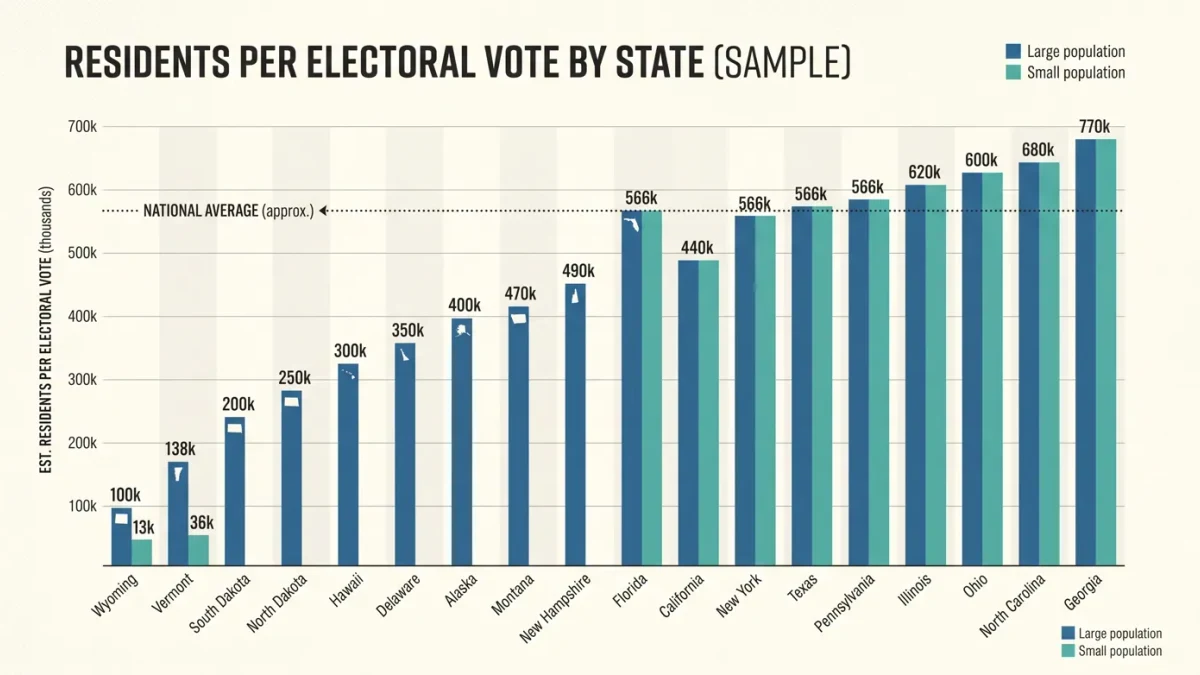
Abolition advocates — including Senator Brian Schatz of Hawaii and Representative Earl Blumenauer of Oregon, who introduced a constitutional amendment for a national popular vote in several recent Congresses — argue the current system makes most voters spectators: because 43 states reliably lean one way, campaigns concentrate almost entirely on a half-dozen battlegrounds. Per the advocacy group National Popular Vote, more than 90 percent of 2024 general-election campaign events were concentrated in just seven states. Their fairness claim is the two-vote Senate-style bonus: Wyoming's elector represents about 193,000 residents and California's about 730,000, so a small-state voter carries roughly four times the weight. And they argue the majority principle is self-justifying: in every other American election, from mayor to governor to senator, the most votes wins. Their strongest version: a system that can reverse the popular verdict twice in sixteen years, and that incentivizes candidates to ignore three-quarters of the country, has a legitimacy problem no federalism argument cures.
What is the case for keeping it?
Defenders — the Heritage Foundation's legal analysts, Senator Mitch McConnell, and a long line of small-state officials of both parties — argue the College forces geographic breadth: a candidate must win simultaneous majorities across disparate regions rather than piling up votes in a few dense metros. The federalism claim runs to the Founders: the Constitution's compromise made the presidency a union office, not a national plebiscite, and Alexander Hamilton in Federalist No. 68 defended electors as a filter against pure mass politics. The recount argument is practical: a national popular vote margin of a few hundred thousand across 50 states would invite litigation everywhere, while the College quarantines disputes — Florida 2000 was one state, not fifty. Defenders also dispute the small-state bias claim, noting that swing states, not small states, get the attention: New Hampshire and Nevada are courted while deep-red Idaho and deep-blue Massachusetts are ignored, so the system rewards competitiveness, not size. Their strongest version: the College has produced accepted outcomes for 230 years; the replacement would politicize every close election nationwide with no agreement on what a national recount even looks like.
What would each path require?
Abolition by amendment requires two-thirds of both chambers and 38 states — a threshold supporters have not approached, since small states would be diluting their own influence. The National Popular Vote Interstate Compact takes the other route: member states pledge their electors to the national popular-vote winner, activating at 270 electoral votes; the compact holds 209 from its 17 jurisdictions, per its own tally, and its constitutionality would face immediate challenge if it ever reached the threshold. Direct abolition is therefore unlikely; the compact fight is where the action is.
LMH News publishes information, not political advice. Positions are attributed to their named advocates; this primer presents each side at comparable length and endorses neither.