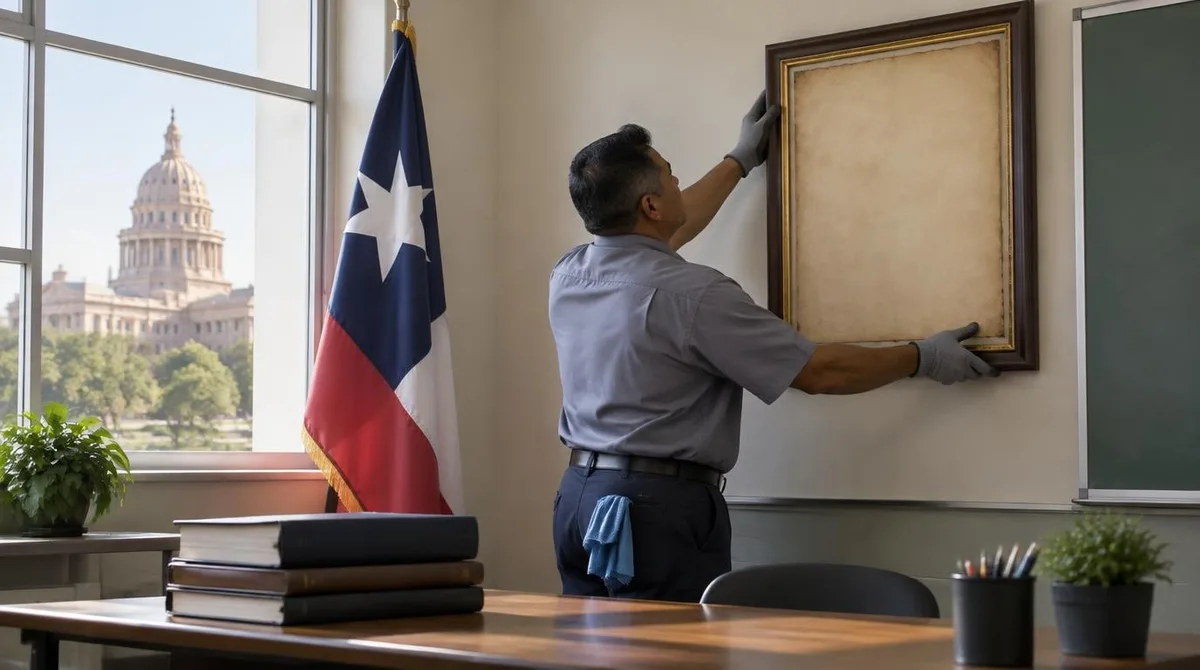
Texas public school classrooms now display the Ten Commandments because state law requires it, and the Supreme Court has not said whether it will stop them. The law, passed last year, requires a version of the King James Bible's Ten Commandments in a conspicuous place in every public school classroom. It survived lower-court challenges earlier this year and went into effect widely this fall. The court has yet to say whether it will take the case.
The popular assumption is that a law like this rises or falls on a single Supreme Court ruling. The Texas situation suggests something messier: implementation is running ahead of adjudication. Posters are going up while the legal question stays open, and that gap is where the actual politics and logistics of the law are being worked out. We covered a connected angle in Supreme Court Upholds TikTok Divest-or-Ban Law in Unanimous Ruling.
According to The Arkansas Democrat-Gazette, more than a dozen Texas families of multiple faiths have asked the court to block the law, arguing it violates the First Amendment's ban on government establishing religion. Advocates for the separation of church and state have asked the Supreme Court to overturn the law. Until the court answers, districts are complying.
What does the law actually require of schools?
The statute requires a version of the Ten Commandments to be posted in a conspicuous place in every public school classroom. The posters must be at least 16 inches wide and 20 inches tall. Notably, the law does not order districts to buy anything. Schools must put the posters up only if they are donated. Advocacy groups have spent a year and a half fundraising and organizing to get posters into Texas's roughly 9,000 public schools.
That funding mechanism matters legally. According to the Arkansas Democrat-Gazette, the statute includes the same funding structure as a Kentucky law the Supreme Court struck down in 1980, which also required the posting of the Ten Commandments in classrooms. The state avoided a direct appropriation, but the mandate itself is the same shape.
Why is the 1980 precedent not automatically fatal to the law?
The Kentucky ruling rested on a standard that required government actions to have a secular purpose. That standard stood for half a century. Today's conservative Supreme Court majority discarded it in 2022 and said the role of religion in government should instead be guided by "history and tradition."
That shift is the whole legal ballgame. Under the old test, a mandate to post Scripture in every classroom looked like the Kentucky case all over again. Under the new one, the question becomes whether such displays fit within American history and tradition. The court has also expanded the free exercise clause in recent years, allowing a football coach to pray with athletes on the field and businessmen to refuse service to some customers on religious grounds. Texas's law is a test of whether that same trajectory now covers government endorsement of religious texts, not just private religious practice.
How are Texas schools handling the mandate?
Most districts are trying to stay neutral. In some districts, official guidance tells teachers that if students ask about the displays, they should say the posters are required by state law and direct further questions to parents.
Michael Novotny, superintendent of the Salado Independent School District, a 2,800-student system about 50 miles north of Austin, put the district posture plainly. "They just go on the wall in the classroom. They are not part of a lesson, instruction, they are not evangelizing. We're complying with the law," he said, according to the Arkansas Democrat-Gazette. He said he had not heard from a single parent or student for or against, and expected the same if the Supreme Court says the posters should come down.
That quote captures the administrative reality: for many districts this is a compliance task, not a curriculum change. Whether that posture legally insulates the displays is precisely what the litigation will decide.
What is happening outside the courtroom?
The enforcement environment is unlike anything public schools have seen. A conservative Christian group has launched a digital compliance tracker, using public tips to monitor all 9,000 Texas public schools. Websites sell alternate posters for teachers to hang alongside the commandments. Some display other moral teachings, such as the Five Precepts of Buddhism or the United Nations' Declaration of Human Rights. Others proclaim that the mandated display is "illegal."
Mark Chancey, a religious studies professor at Southern Methodist University who studies religion in public education, called the widespread implementation "extraordinary." No such sweeping effort to post Scripture, and no similar enforcement, has happened in the history of U.S. public schools, he said, according to the Arkansas Democrat-Gazette.
Public opinion in Texas splits. Some Texans describe the posters as a first step toward fixing what they see as a broken American morality. Others question whether a religious text belongs on classroom walls at all.
How does Texas compare with other states?
Texas is one of four states to pass such laws in recent months. The others have fared differently, which shows how much turns on each state's courts and timeline.
- Louisiana passed the first such law, in 2024, but courts held off full implementation until earlier this year.
- Arkansas saw a judge partially halt its law earlier this year.
- Alabama's requirement takes effect January 1.
- Tennessee this year passed a law allowing, rather than requiring, schools to post the commandments, similar to permissive laws passed since the early 2000s in North Dakota, South Dakota and Oklahoma. All of those states tried to make the posters mandatory in the past year and failed.
The pattern is a patchwork. Some states mandate, some permit, some are blocked in court. Readers who want the procedural background can see how a case reaches the Supreme Court, and how preliminary injunctions are decided, since both explain the mechanics now shaping these state fights.
What should readers watch next?
The single fact that matters most is the Supreme Court's pending decision on whether to take the case. If it does, the court will effectively choose between the 1980 framework and the history-and-tradiment approach it adopted in 2022 for a display mandate that touches every classroom in a state. If it declines, the posters stay up, and the lower-court record becomes the operative law of the region.
Either way, the implementation-first dynamic is likely to continue. Compliance trackers, donated posters and counter-posters are already part of the landscape. The legal question is whether the First Amendment's establishment clause still limits what a state may put on a classroom wall. The court has not answered. Texas has.
For more coverage of the courts and statutes shaping state policy, see the law section, and for the broader governing context, the politics desk.